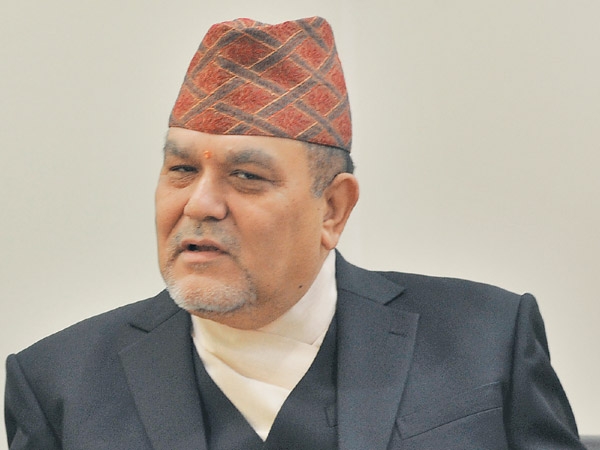







Bigyan Prasai
London
(Chartered Certified Accountants)
Nepali Congress Mahasamiti Member
‘Decentralisation’, the word itself connotes moving away from the centre. It has become increasingly popular in the developed and developing countries, both private and public sector, and also both in unitary and federal structured states.

According to Keith Davis, (1967) ‘Decentralisation is a wide distribution of authority and responsibilities to the smallest unit that is practical throughout the organisation’.
Abstracting from the above definition decentralisation simply means to transfer the rights and responsibilities to the lower level of governance i.e. going closer to the people (political) or consumer (in private sector) or giving human touch to the economic aspects.
Decentralisation can take place in a different form and different degree and dimension in the both social and political context. Briefly, putting the definition of decentralisation as, dividing the bigger unit into many smaller units with greater delegation of essential power to smaller units, in order to accomplish the objectives of the centre.
The arguments here is aspired by British Economist E F Schumacher (1973), ‘Small is beautiful’, which emphasize that it is difficult to manage unit in large and it can be more effective in managing in small unit and he proclaimed that ‘production from local resources from local needs is the most rational way of economic life .’
On this article I will stress the different form of decentralisation and will critically assess the different reason put forward for decentralisation in various political and social contexts across the range of countries which may be a lesson to Nepal. I will also focus on the adaptation of decentralisation in the federal structure and unitary structure contrasting with few examples
Decentralisation and critical evaluation
As defined above Decentralisation refers to empowering the locals to define their needs themselves and self-manage to peruse and accomplish their needs, which reflects the very novel ideas in the contemporary modern world of liberalisation and democracy. But the effectiveness of this very novel concept of decentralisation needs to be looked at the dimension of different social, political, economic preconditions. So in order to adopt the right degree of decentralisation to the right context, the mix of the right form of decentralisation has to be analysed. ‘One size does not fit all’ policy applies here as well and the adaptation of the form of decentralisation has to be country and context specific. The success of the specific form of decentralisation cannot be generalised and applied to the different context.
Without the proper understanding of the socio-political culture and assessing the capacity to adhere the right and responsibility’ at the local level, the country may end up more chaos in the implementation process of the decentralisation. As Philip Mawhood (1983), critically quotes ‘Decentralisation is a word that has been used by different people to mean a good many different things. But what do we see in practice? Experiments with local government that end in chaos and bankruptcy, ‘decentralised’ structures of administration that only act as more effective tool for centralizing power ; regional and district committees in which government officials make decision while the local representatives sits silent ; village councils where local people participate but have no resource to allocate’.
In order to adhere the context specific decentralisation, the different form of decentralisation as has been adopted across the globe in different state regime and state structure.
Unitary and Federal Structure:
There is broadly accepted belief that the federal structure of the state regarded as more decentralised than those state with the unitary structure. So embedding on this thought, many of the developing countries including Nepal is moving ahead with the federal structuring of the state. First of all the concept of federation only reflects the state structure, and this does not mean the state is fully decentralised. For example, India though has adopted federalism but the centre has the power of veto, which can be exercised over the appointment of governors and other executive agents of federations as well but in contrast in Britain which is unitary state, the central government has no power to appoint the personal in charge of local decision-making. So federalism is simply a form of decentralisation and the degree of decentralisation varies in different proportion in different countries adopting Federalism and Unitary Sate. The essay here wants to explain that even without adopting a federal structure; the country can adopt the principles of decentralisation through devolution of power to lower level of government. The historical evidence suggests that the adaptation of federalism as a means to devolve power has been mainly adopted because of the following reasons and basis.
- The country with a large geography makes the state difficult to govern effectively and efficiently. Because of the large territory the local needs and the local requirement cannot be correctly established by the centre thus the central government unable to deliver public services efficiently. For example USA, India, Canada, Brazil, Australia.
- The countries like Switzerland, Spain, Belgium, and Ethiopia are federated on linguistic or ethnic base. The different part of the country is populated with the majority of single ethnic communities.
The countries are federated on the basis of the large territory and the existence of large ethnic population on the certain part of the country. On contrary ,Nepal which is currently on the course of restructuring the state to different smaller state under the principle of federalism (proposed on the basis of ethnic minority as proposed by Maoist),does not fit on either of the basis of ethnicity or the large territory concept. Nepal is a small country, even smaller than the federated states of India, thus does not need to be federated as citing a reason of large territory where the central government will not be capable of reaching remote areas. On the other side, no part of the territory of Nepal is populated with the majority of any single ethnic communities. Hence, there is no concrete logic to federate the country on the basis of ethnicity. Although Nepal has 125 ethnic groups and speaks 123 languages and but they do not reside in the single part of the country and are dispersed through out the country. Therefore, there is no single territory to federate the state on the basis of ethnic and language as demanded by the Nepal Communist Party –Maoist and some of the ethnic-based interest group. In contrast to study of Belgium, state is divided into the northern part of Belgium with Dutch-speaking Flanders; southern part of the state is French-speaking Wallonia and eastern part with German speaking. The Belgium history of devolution suggests that growing tension between French-speaking Wallonia and Dutch-speaking Flanders could have led the country to disintegration if the federalism had not been adopted. The social and political context in Nepal is that, no such ethnic conflict can arise to national disintegration because of the diversified demography of the ethnic group. So what I here want to achieve is that the adaptation of the form of federalism (a form of decentralisation) has to be according to social, demographic and country specific rather than adopting in ditto from other countries.
In the recent trend towards Federation, some of the developing countries has been swayed by the notion that the federalism as a means to development. But the development of the nation cannot be linked to the structure of the country whether it be a unitary or federalism. The development and devolution of power cannot be a metaphor of federalism. The United Kingdom is a unitary state with a distinct principle of devolution of power to Scotland, Wales, and Northern Ireland. United Kingdom in spite being a unitary state had been devolving power to the maximum where possible. UK adopting a Unitary structure and adhering a principal of decentralisation with a current offer of D-Max ( i.e. Devolution Maximum ) is, in fact, a developed country, in contrast Pakistan with 60 years of being federated still remains a country of unrest, unstable and tensions and remains a underdeveloped country.
So the general idea of the case of UK and Pakistan is that decentralisation is not the case of state structure but, in fact, the adoption of the practice of the Government embedded on the social, national and local culture. The real question is the level of decentralisation.
Conclusion
After careful consideration with the above analysis of adaptation of decentralisation in different structure and different stage of development, successful implementation of different form of decentralisation should be based on the countries’ stage of development and the culture embedded in the society. Put it simply that, providing a child with a sophisticated weapon to protect them would be fatal for their own life and to the surrounding (as the child does not have the knowledge and capacity to use the weapon). Thus delegating the overall responsibilities to the children without proper guidance may end up in their lives in more pain and misery. Similarly, no doubt the devolution of power to the local level in the country without the capacity to implement may be the danger to the country. So I want to emphasize, in conclusion, that the developing countries like Nepal should start up the decentralisation procedures on the incremental basis pairing with the capacity of the state or society. The Big Bang approach to federate may further degenerate the country’s political and economic situation.